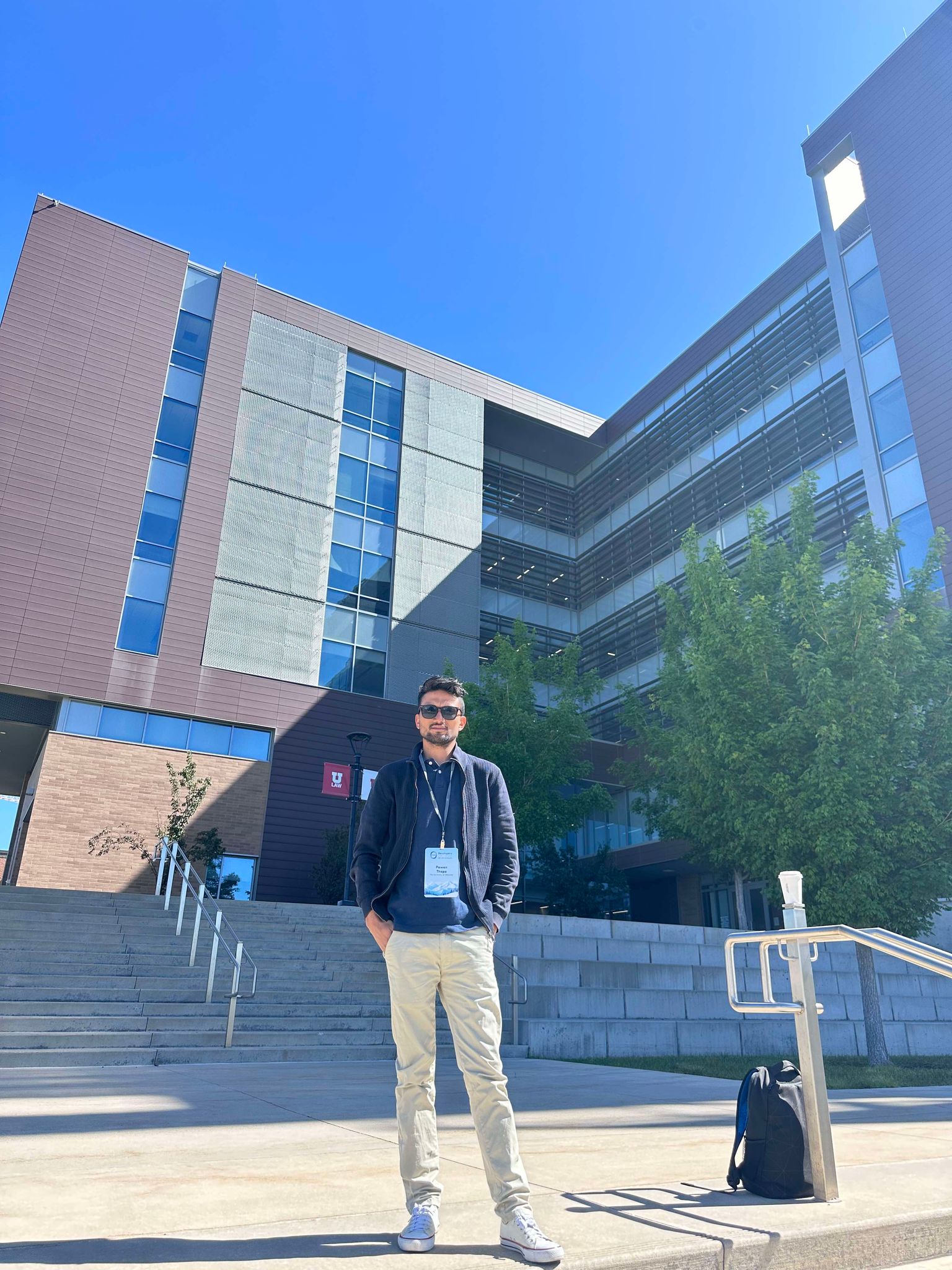
Pawan Thapa








🚀 About Me
I work at the intersection of GIS, remote sensing, surveying, hydrology/geomorphology, and machine learning to understand how rivers evolve through time and how those dynamics affect flood risk, infrastructure, and ecosystems. My research integrates satellite SAR (Sentinel‑1), optical imagery, UAV sensing, DEM‑based terrain analysis, and AI/ML to extract river morphology, model inundation, flood resilience and monitor environmental change.
I’m especially interested in automated river planform analysis including centerline extraction, channel width estimation, and meander classification using deep learning and Medial Axis Transform–based approaches. I complement image analytics with hydrologic and hydraulic modeling, building decision‑ready geospatial products and flood resilience applications for scientists, agencies, and communities.
Before beginning my Ph.D., I lectured at Kathmandu University, Nepal and previously served as Head of Department at Nepal Banepa Polytechnic Institute. I hold an M.Sc. in Geoinformatics (University of Münster, Germany) and a B.E. in Geomatics Engineering (Kathmandu University). Across academia and collaborative projects, my goal is to turn complex geospatial data into practical insight that supports risk reduction and resilient planning.
🛠️Research Focus
River Morphodynamics & Flood Resilience: Automated derivation of centerlines and widths; meander detection/classification; flood mapping and scenario analysis.
AI/ML for Earth Observation: Deep learning segmentation and classification, explainable ML, and scalable cloud pipelines for SAR/optical time series.
Hydrology & Hydraulics: Linking remotely sensed change with hydrologic/hydraulic models to improve inundation forecasting and hazard assessment.
UAV & Field Integration: UAV multispectral/hyperspectral acquisitions; ground and boat‑based surveys (ADCP, YSI, ASD spectrometer, HYCAT) for calibration/validation.
Methods & Tools
- Software: ArcGIS Pro, ENVI, ERDAS IMAGINE, QGIS, HEC‑RAS, LISFLOOD‑FP, SWAT, Pix4D.
- Programming: Python, R, JavaScript (including Google Earth Engine).
- Cloud/Compute: GEE, AWS, Azure, HPC workflows.
- Instruments: UAVs (licensed small UAS operator), LiDAR, DGPS, Total Station, ADCP (RS5), YSI, ASD spectrometer, HYCAT surface vehicle.
Selected Publications & Outputs (recent)
- Enhanced river planform analysis using deep learning and Medial Axis Transform with Sentinel‑1A imagery, Earth Surface Processes & Landforms, 2025.
- Drone in Hyperspectral Remote Sensing: Techniques and Applications, Geocarto International, 2025.
- Operational Efficiency and Environmental Impact of UAV‑Based Vaccine Delivery in Remote Areas of Nepal, Next Research, 2025.
- Book chapters and proceedings spanning flood resilience, UAVs, soil erosion modeling, COVID‑19 decision science, and river morphology
- More:
📂 Teaching & Mentorship
- University of Alabama: GY101/102 labs (atmospheric and earth‑surface processes); demonstrations in UAVs, GIS, surveying, remote sensing, AI.
- Kathmandu University: Courses in GIS, UAVs, Remote Sensing, Web GIS, Spatial Data Infrastructure, Cadastre, Database & Geoinformation Modeling, and field surveying. Mentored graduate and undergraduate theses on topics ranging from urban heat islands to GEE‑based flood applications.
- GEO Network Mentorship: Mentor underrepresnted people and society for education, learning, and research
📦 Service & Community
- Peer Reviewer: IEEE Transactions on Geoscience and Remote Sensing, Natural Hazards, PLOS ONE, and others.
- Technical Committees: IEEE GRSS (Standards for Earth Observations, Quantum Earth Science & Technology), REACT.
- Outreach: Esri YPN blog feature; GeoAwareness Week activities; volunteer field mapping for environmental and community projects.
Awards & Recognition
- Graduate Council Fellowship, The University of Alabama (2026).
- Outstanding Doctoral Graduate Research Award, Department of Geography & the Environment, UA (2026).
- NASA/ASU Infiniscope award (interactive virtual field trip, 2025).
- HydroLearn Fellowship (CIROH; curriculum development in hydrology/water resources, 2024).
- Multiple travel awards (UCGIS, CAUSHI, CIROH, AGU, AAG) and student paper recognitions.
🌐Vision
I build reproducible, open, and scalable geospatial workflows that bridge research, survey and practice so agencies, NGOs, people and communities can anticipate hazards, prioritize mitigation, resilient and manage rivers and floodplains more effectively. I’m always open to collaborations at the intersection of Earth observation, Surveying, AI, and water.
🏆 Achievements & Contributions










